Business
Venezuela’s Oil Reserves Regain Global Attention Amid Shifting Politics
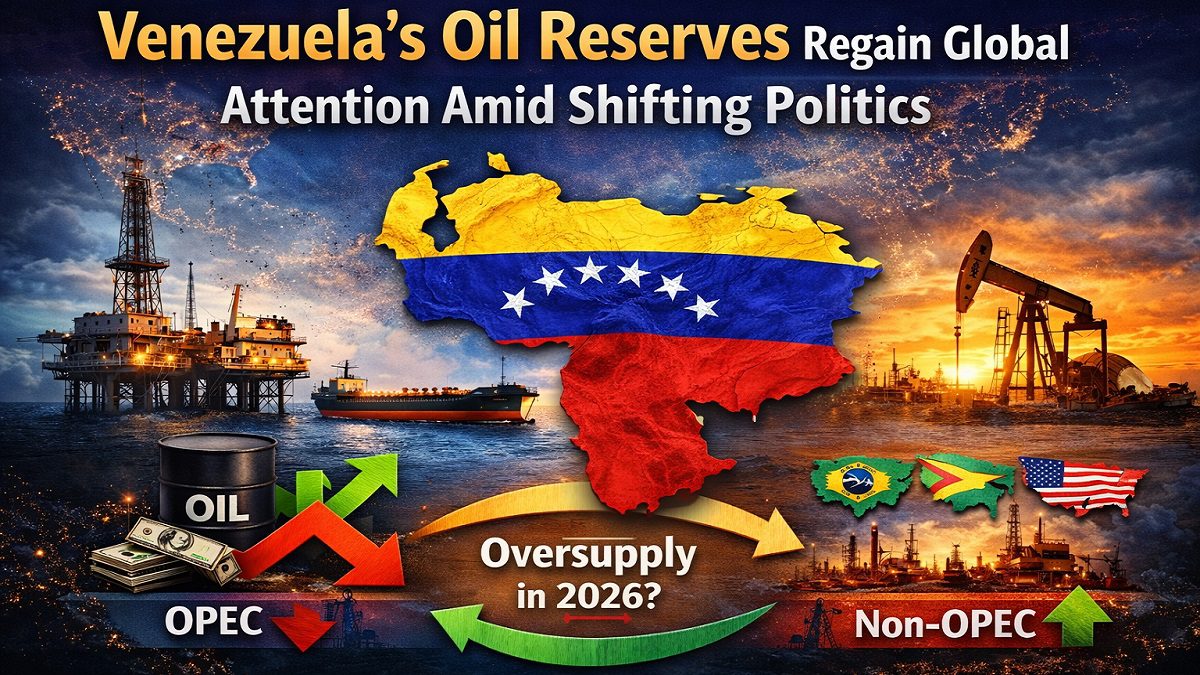
Venezuela, home to the world’s largest proven oil reserves, is once again drawing international attention as shifting politics redefine global supply chains. While Saudi Arabia, Russia, the United States, and the UAE still dominate crude exports, new production growth from non-OPEC countries, combined with a potential Venezuela’s re-emergence, could alter the global oil balance. As sanctions ease and investment interest tentatively returns, Venezuela’s potential production recovery could influence prices and geopolitics through 2026. The broader market remains concentrated, but the distribution of power is beginning to change as new exporters reshape the global energy order.
Crude oil is one of the most strategic commodities in the world. Its export side is extremely concentrated. In 2024, although 95 countries will export crude oil, the market is controlled by a few producers. The United Arab Emirates, Saudi Arabia, Russia, and the United States contribute approximately 52% of the world’s value of crude exports.
Although most countries are involved in the trade, the top five are the ones that actually make the headlines, which highlights the fact that oil is a key pillar in the global economy and geopolitics.
Resource Luck vs. Tech Innovation
The production of oil by these countries depends on natural resources and sometimes technological innovation. Natural endowments are crucial: Venezuela and Saudi Arabia are located on huge geological reserves, which drive their export potential.
Conversely, the United States has emerged as a result of technological developments in the shale revolution. U.S. production has also increased dramatically with smaller conventional reserves, which has resulted in a situation where OPEC giants are competing with non-OPEC producers.
The competition is redefining international prices and supply chains in unpredictable ways, and strategic maritime routes are one of the key aspects of international security.
Geographic Heavyweights
Saudi Arabia leads the way, followed by Russia and the United States due to the huge resource base and well-developed infrastructure. The middle-level players like Brazil, Kazakhstan, and Nigeria are balanced in the region, and this provides importers with more choices.
Crude oil is not just an energy narrative, but a fiscal lifeline, a source of government revenues and foreign-exchange, which keeps vital services operating.
The world map shows major exporters in the Middle East, North America, Africa, South America, and the North Sea, but the intensity is concentrated in the Persian Gulf, where the economies are oil-rich and highly reliant on exports.
FIGURE 1: Top 20 Countries by Oil Reserves
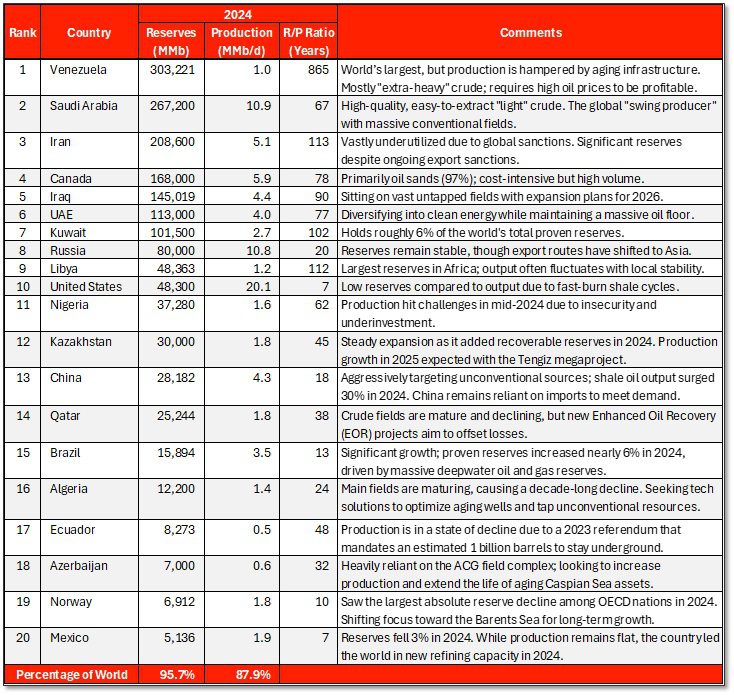
Sources: OPEC – Annual Statistical Bulletin (2025); Energy Institute – Statistical Review of World Energy (2025); Natural Resources Canada
Refineries and the Shifting Hierarchy
The United States is an interesting case as it exports and imports large quantities at the same time. A complex refinery network and product mixes affect its domestic market.
With the shifting energy markets and the pace of the green transition, the hierarchy of the exporting countries can change, and some of them might vanish. With a few countries still having a major influence on the energy security and consumer prices, it forms an unequal yet established system. The imbalanced pricing power is still acute.
A New Era of Supply and Demand
We’re heading into a period where the old rules might not apply as much anymore.
In 2026, the world could see a supply surge from the non-OPEC countries, especially the U.S., Guyana, and Brazil, which will result in what some refer to as the “Year of the Glut”.
Although technically 95 countries are supplying crude, the market is getting increasingly crowded at the top, putting pressure on prices downwards due to the current geopolitical tensions.
The IEA predicts a huge surplus, whereas OPEC is more optimistic, which increases the forecast gap to one of the largest in recent years.
Whether you’re a giant like Saudi Arabia or a smaller player just trying to keep your fiscal budgets intact, it could be a bumpy ride for the oil price in 2026. The next few years will probably redefine who actually survives the global barrel race.
FIGURE 2: West Texas Oil
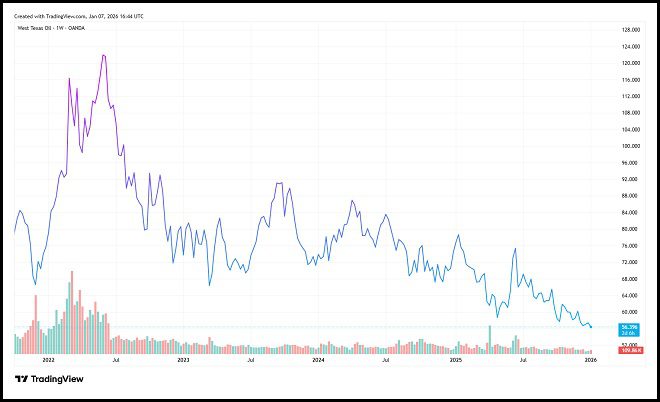
Source: TradingView